Skip to content

Portfolio · Corporate gifting · Web

A catalogue with no price on it,and a minimum on every page.

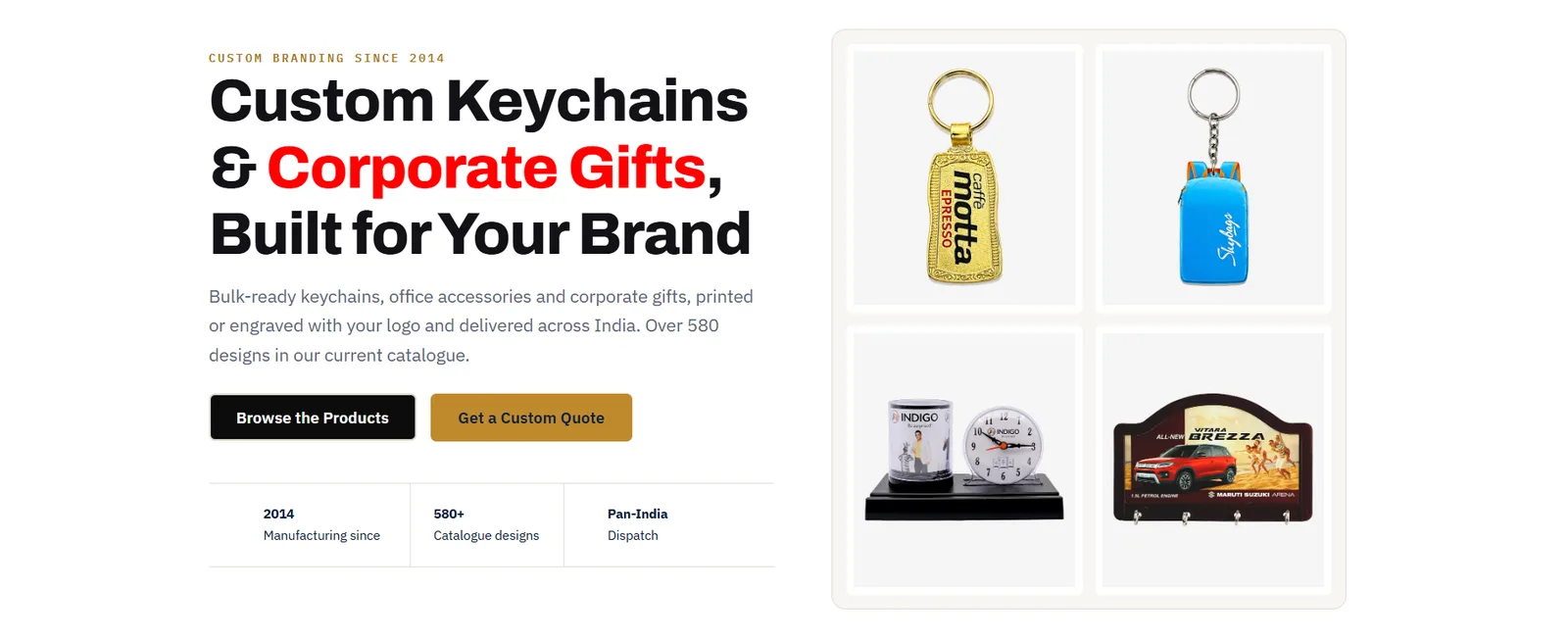
A manufacturer selling custom-branded keychains, desk accessories and corporate gifts to businesses in bulk rather than to consumers at a listed price. The site is a catalogue of more than 580 designs carrying no prices at all: every item is quoted to the buyer’s quantity, material and print method; the minimum that applies is published on the product rather than negotiated once the buyer is interested; and every page a buyer might stop at ends in the same two actions.

The catalogue home page, stating custom keychains and corporate gifts built for a buyer’s brand, with years trading, catalogue size and dispatch reach counted beneath.
A shop front that opens on terms and quantities rather than on a price.
Sector
Corporate gifting — bulk, business to business
Catalogue
580-plus designs across three ranges
Pricing
None published — quoted to quantity, material and print method
Built on
WordPress
01

The catalogue

/ 04

Three ranges, named by what they are made of.

The first band on the site is not a promotion, and it does not scroll away. Under it, one section names the whole offer before a buyer has clicked anything — and names each range by its material or its object rather than by a marketing word. Keychains by PVC, metal, leather and rexine, silicone, acrylic, MDF and crystal; the desk by clock, organiser, pen stand, chit pad, clip board and sign; the gifts by coaster, key hanger, travel kit, sticky hook, mouse pad and badge. Somebody who knows what they want in their hand can find it before they know what it is called.

  1. 01

    Terms above the header

    Bulk orders only, a 500-piece minimum and custom design, stated on every page rather than on a terms page.

  2. 02

    Three ranges, one catalogue

    Keychains, office accessories and corporate gifts sit in one filterable set rather than in three shops.

  3. 03

    Named by what it is

    A range is listed by its material or its object, which is how a bulk buyer already thinks about it.
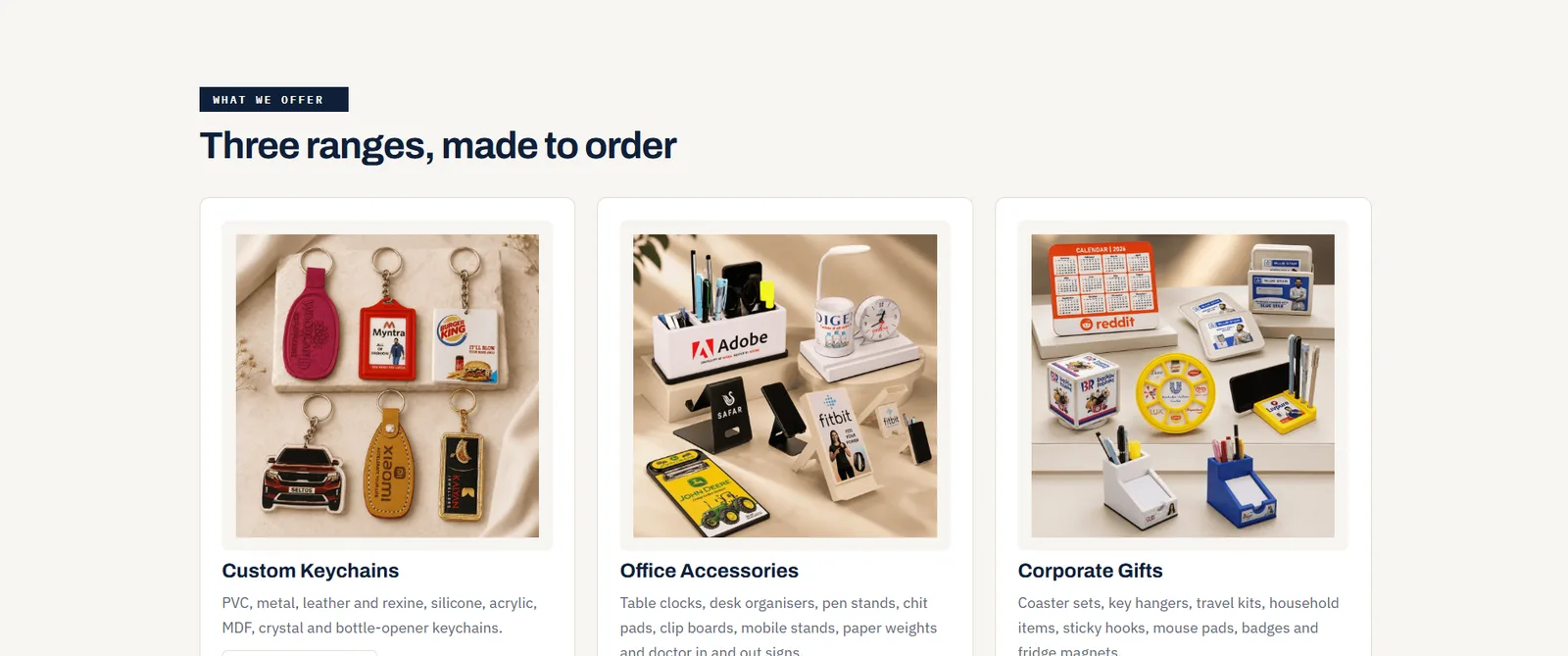
Three range cards — custom keychains, office accessories and corporate gifts — each with a photograph of the goods and the materials or objects it covers listed beneath.
Three ranges, each listed by material or by object, before anything is opened.
02

The rule

/ 04

One catalogue, and no price on it.

A price printed against a design nobody has quoted is a price somebody will have to walk back, so this catalogue prints none at all. What sits where a price would be is the rule that replaces it and — the part most quote-led sites forget — how long the real number takes to arrive. Everything under that band is browsing rather than shopping: material and object, narrowed where they stand.

  1. 01

    The rule, where a price would be

    Price on request, quoted to quantity and branding, with the reply time printed beside it.

  2. 02

    No number on any card

    The grid is browsed on material and object, so nothing has to be quoted twice.

  3. 03

    Filtered without leaving

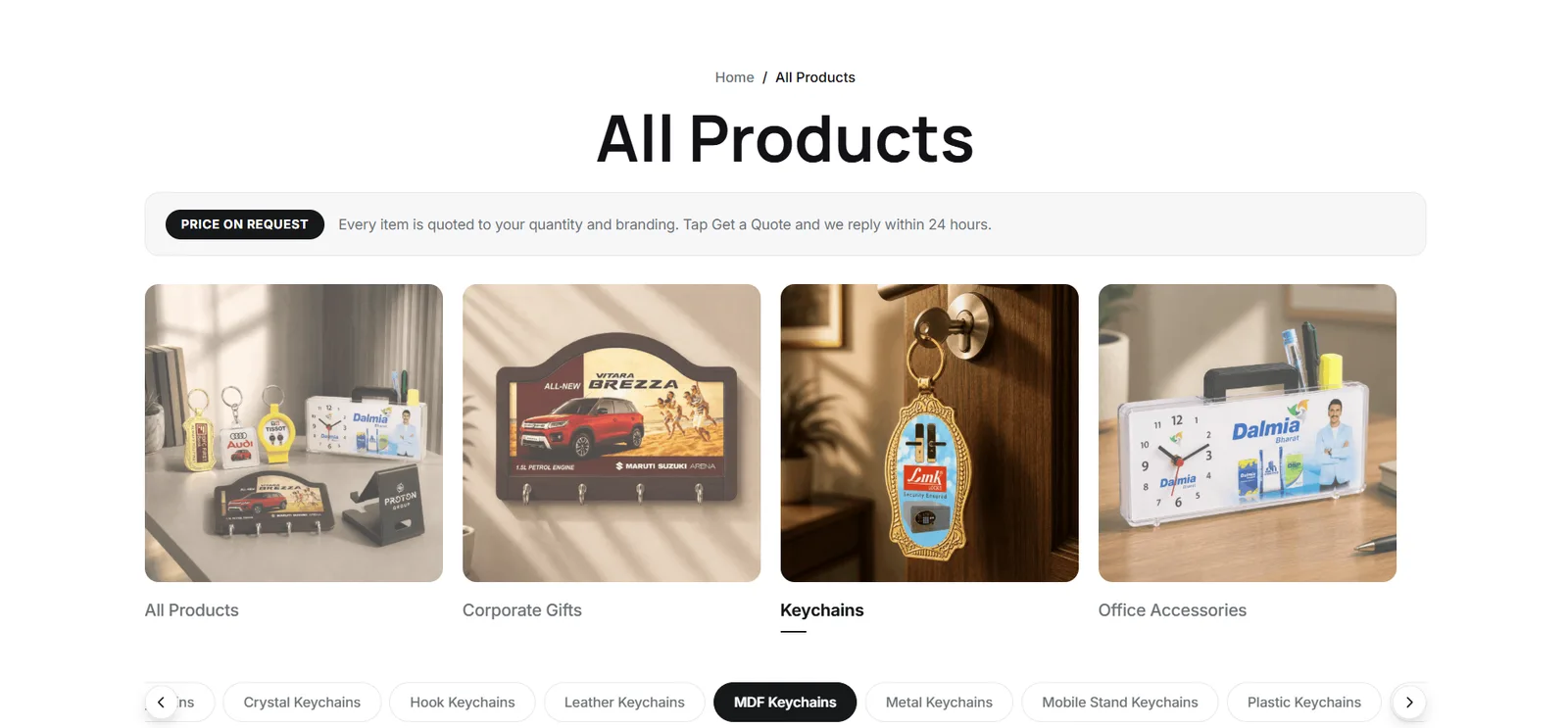
    Category tiles and a scrolling chip strip narrow the grid in place, with no page load between them.

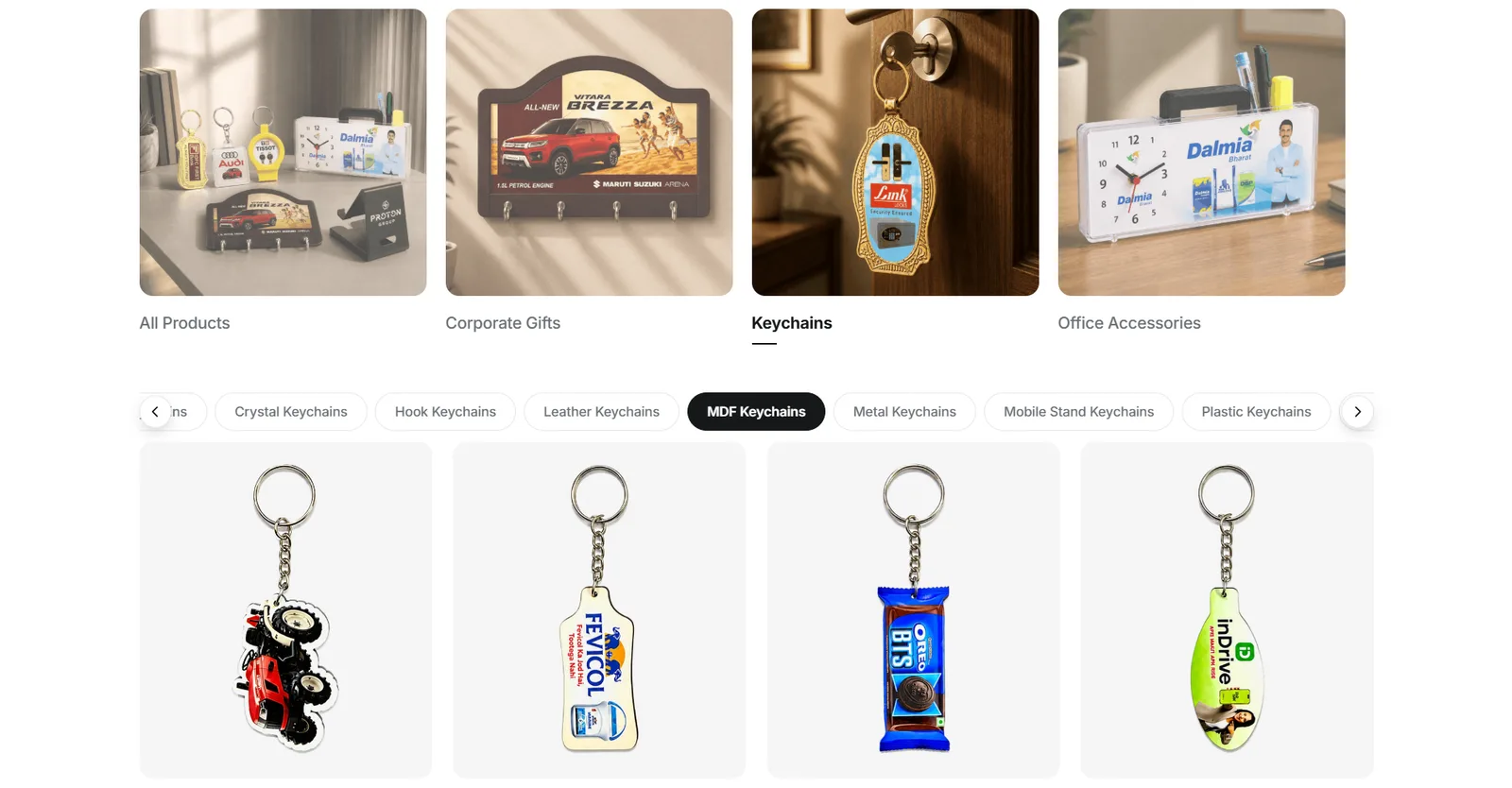
The all-products page opening on a price-on-request band, with four category tiles and a scrolling row of sub-category chips beneath it.
The rule sits where a price would: quoted to your quantity, answered within a day.
The keychain grid under a scrolling strip of material chips — crystal, hook, leather, MDF, metal, mobile stand, plastic — with four branded designs shown and no price on any card.
Material chips over the grid, filtered in place — and no number on any card.
03

The quote path

/ 04

An enquiry shaped so it can be answered.

Every design ends in a question rather than a checkout, and the question is built so that it can actually be answered. Whichever route a buyer takes, the item travels with the enquiry, so nobody has to describe a keychain in prose at either end. The form asks only for what a price genuinely depends on — and the panel beside it takes the guessing out of the rest, rather than letting a buyer discover a day later what was missing.

  1. 01

    Two ways to ask, side by side

    A form and a message thread, given equal weight on every product page rather than one hidden behind the other.

  2. 02

    The item comes with the question

    Catalogue number and category are attached to the enquiry instead of being retyped from memory.

  3. 03

    What earns a same-day price

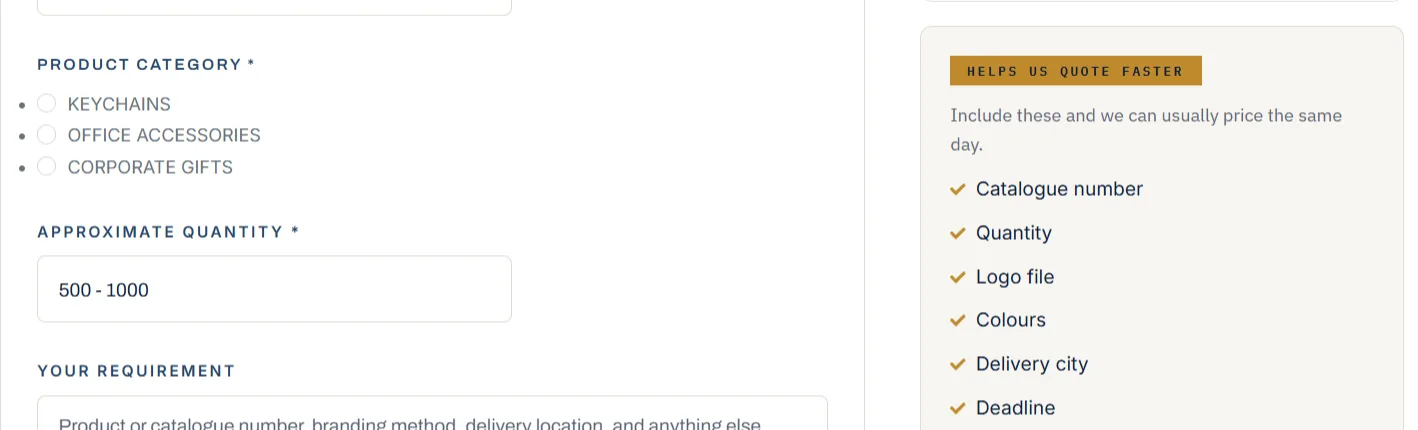
    Six answers — number, quantity, logo file, colours, delivery city, deadline — listed beside the form, not asked for in a reply.

The quote request form asking for product category, approximate quantity and the requirement, beside a panel listing what earns a same-day price.
What the price depends on, asked once — and what earns a same-day answer, listed beside it.
04

Bulk terms

/ 04

Sized for corporate quantities.

A minimum discovered after a buyer has already become interested wastes both afternoons. So they are set per product and printed in the catalogue, which loses a few enquiries on purpose and keeps the ones worth answering. Repeat business runs on the same principle: a rollout across branches, a dealer network or a seasonal campaign is production to be scheduled, not a series of unrelated orders each quoted from nothing.

  1. 01

    Published, not negotiated

    The minimum sits on the product, so a buyer learns it before they spend an enquiry finding out.

  2. 02

    Two bands, by size

    From 500 pieces on larger items; from 1,000 to 1,500 on smaller printed ones.

  3. 03

    A schedule, not a series

    Branch rollouts, dealer networks and repeat campaigns are planned as one run of work.

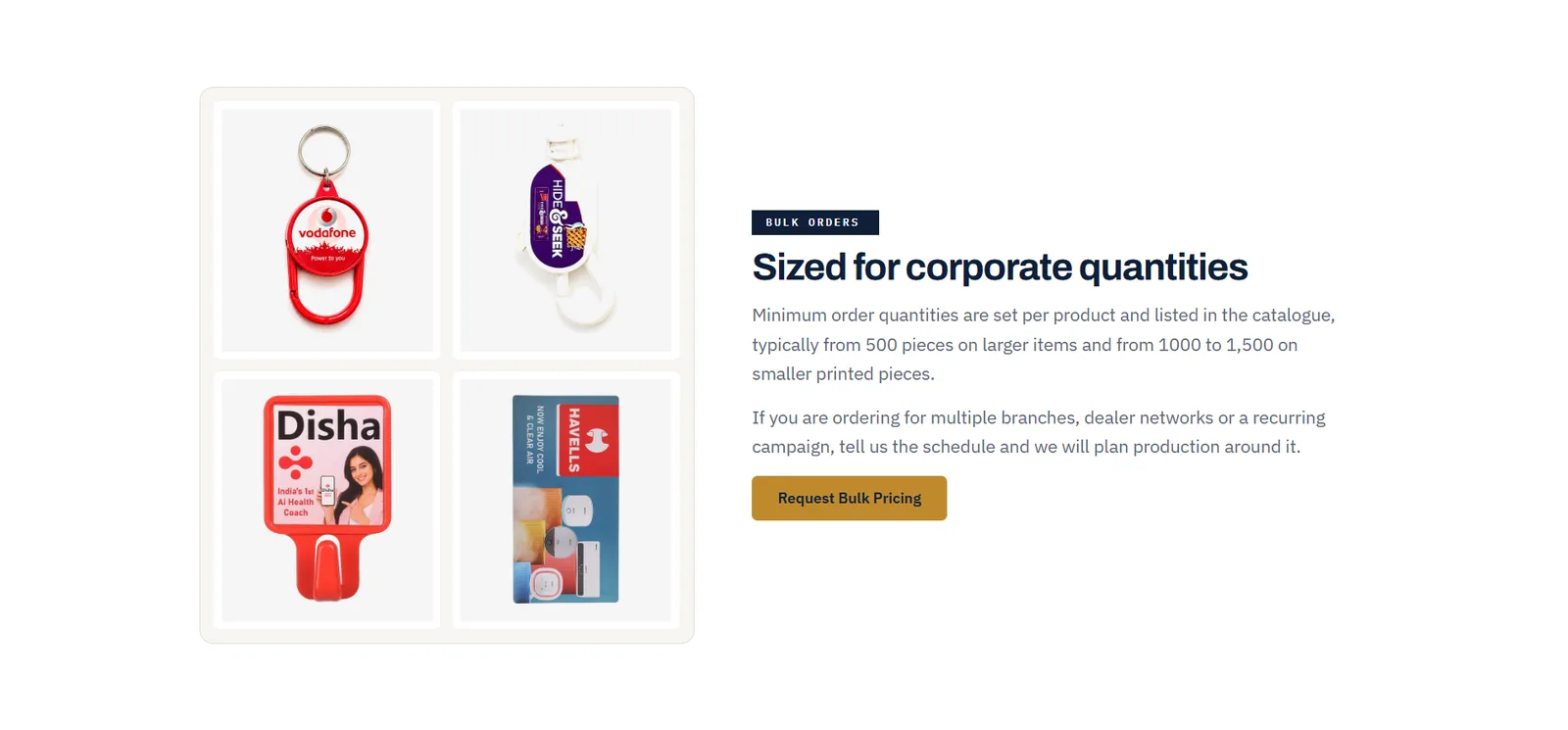
A bulk orders section stating that minimum quantities are set per product and listed in the catalogue, beside four photographs of branded promotional items.
The minimum is published per product, so a buyer knows before asking whether it is worth asking.

The last word

This shows how Famysys builds for a manufacturer whose price cannot be printed: take the price out of the catalogue, publish the minimum in its place, and put the same two ways to ask on every page a buyer might stop at. If you sell to businesses in bulk rather than to consumers at a listed price, we start from your catalogue and your minimums rather than from a template.

Built in

  • Catalogue
  • 580+ designs
  • Material filters
  • No published prices
  • Quote form
  • Message enquiry
  • Catalogue number on the enquiry
  • Published minimums
  • WordPress

All projects

Let's build what's next

Technology alone doesn't transform businesses.The right partnership does.

Modernizing systems, building a new product, or exploring AI-driven transformation — Famysys helps you move forward with confidence.

  • SOC2 Type II Compliant
  • Strict Commercial NDA
  • Zero Lock-In Guarantee

Famysys

We Engineer Clarity

Scan to Connect

Instant digital business card & WhatsApp link